StudioComposition
<StudioComposition /> renders a composition (a full page, or a section as the root) against data you already hold, passed in as a context prop. No SDK data fetch, no hook. It works in CSR and Next.js SSR.
Use it when the data isn’t coming from the SDK’s normal template fetch: you fetched it yourself, it’s one element of an array you’re looping, or it comes from a system other than Contentstack.
Note: This is different from <StudioComponent />. <StudioComponent /> fetches a composition for a route and renders it with its bound CMS data. <StudioComposition /> renders a composition you hand the data to. See Two SDK components for the <StudioComponent /> surface.
Do It With a Skill
render-with-own-data wires <StudioComposition context={...}> against data you already hold, using the spec-only sdk.fetchComposition.
curl -fsSL https://studio-documentation.contentstackapps.com/install.sh | sh
What It Does
You give it two things: which composition to render, and the context data to render it against.
- Which composition: either a pre-fetched spec (from sdk.fetchComposition) or a compositionUid it fetches for you on the client.
- The data: a context object, placed internally at dataSources.template. The composition’s template bindings resolve against it. Pass the raw element you already hold (for example one item of a multiple-group field). The SDK wraps it, you don’t build a full spec-data envelope.
Embedded sections inside the composition are auto-scoped from your context (no network). You never build section_scoped_data yourself.
The Props
interface StudioCompositionProps {
  context: unknown;                    // required — the data to render against
  spec?: StudioSpec;                   // a pre-fetched, spec-only composition
  compositionUid?: string;             // OR a uid the component fetches on the client
  loadingFallback?: React.ReactNode;   // shown during the compositionUid fetch (default null)
  errorFallback?: React.ReactNode;     // shown if the compositionUid fetch fails (default null)
}
You must pass either spec or compositionUid: the component throws if neither is present. When spec is provided, compositionUid is ignored and there is no loading phase (nothing to fetch).
For the full type-level reference, see <StudioComposition /> reference.
Two Ways to Give It a Composition
1. Pre-fetch the spec (works in SSR and CSR)
Resolve the composition once with sdk.fetchComposition, then pass the returned spec. This is the only path that works during a server render: a "use client" component can’t fetch on the server.
import { sdk } from "@/lib/contentstack";
import { StudioComposition } from "@contentstack/studio-react";

// Spec-only fetch — resolves the composition STRUCTURE, skips the data fetch.
const spec = await sdk.fetchComposition({ compositionUid: "hero_section", searchQuery: "" });

// `element` is data you already hold.
<StudioComposition spec={spec} context={element} />;
sdk.fetchComposition(query, options?) returns a Promise<StudioSpec> whose data is intentionally empty. This is the bring-your-own-data path. The query takes the same identifier shapes as sdk.fetchCompositionData (compositionUid, url, templateContentTypeUid) plus the searchQuery string.
2. Pass a compositionUid (client only)
Hand the component a compositionUid and it fetches on the client. Give it loadingFallback and errorFallback for the fetch phase.
"use client";
import { StudioComposition } from "@contentstack/studio-react";

<StudioComposition
  compositionUid="hero_section"
  context={element}
  loadingFallback={<SectionSkeleton />}
  errorFallback={<NotFound />}
/>;
A failed fetch is logged to the console and renders errorFallback. While the fetch is in flight, loadingFallback renders.
Tip: In SSR, prefer the pre-fetched spec path. You can resolve the spec on the server and stream markup immediately, with no client-side loading state. Reserve the compositionUid path for client-rendered surfaces.
Rendering a Section Per Array Element (the Loop)
The common case: you hold a multiple-group array and want to render the same section once per element, each against its own data. Fetch the spec once, map over your data.
import { sdk } from "@/lib/contentstack";
import { StudioComposition } from "@contentstack/studio-react";

const spec = await sdk.fetchComposition({ compositionUid: "product_tile", searchQuery: "" });

export function ProductGrid({ products }: { products: ProductElement[] }) {
  return (
    <div className="grid">
      {products.map((element, i) => (
        <StudioComposition key={i} spec={spec} context={element} />
      ))}
    </div>
  );
}
Fetching the spec once and reusing it across the loop avoids a fetch per item. If you use the compositionUid path inside a loop instead, each <StudioComposition /> fetches independently, fine for a handful, wasteful for many.
Rendered, that’s one section three times over, each against its own element, no CMS entry behind any of them:
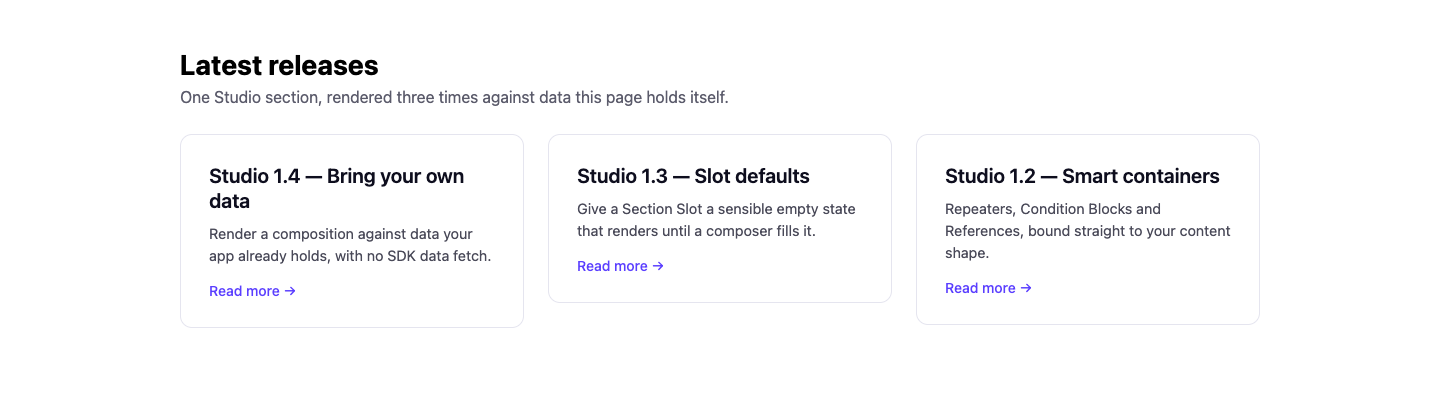
The section itself is unchanged, the same one an author built against a content type. Only where its template data comes from differs.
Works in Both CSR and SSR
context is just a React prop, so the component renders wherever React runs. Only the fetch path for the composition differs.
CSR example: Vite / React SPA
"use client";
import { useEffect, useState } from "react";
import { StudioComposition, type StudioSpec } from "@contentstack/studio-react";
import { sdk } from "@/lib/contentstack";

export function HeroBlock({ element }: { element: unknown }) {
  const [spec, setSpec] = useState<StudioSpec | null>(null);

  useEffect(() => {
    sdk.fetchComposition({ compositionUid: "hero_section", searchQuery: "" }).then(setSpec);
  }, []);

  if (!spec) return <SectionSkeleton />;
  return <StudioComposition spec={spec} context={element} />;
}
Or skip the prefetch entirely and let the component fetch:
"use client";
import { StudioComposition } from "@contentstack/studio-react";

export function HeroBlock({ element }: { element: unknown }) {
  return (
    <StudioComposition
      compositionUid="hero_section"
      context={element}
      loadingFallback={<SectionSkeleton />}
      errorFallback={<NotFound />}
    />
  );
}
SSR / RSC example: Next.js App Router
Resolve the spec on the server, render immediately, no client loading state.
// app/products/page.tsx — Server Component (no "use client")
import { sdk } from "@/lib/contentstack";
import { StudioComposition } from "@contentstack/studio-react";

export default async function ProductsPage() {
  // Your own data fetch + the spec-only composition fetch, in parallel.
  const [products, spec] = await Promise.all([
    getProducts(),                                                       // your data source
    sdk.fetchComposition({ compositionUid: "product_tile", searchQuery: "" }),
  ]);

  return (
    <div className="grid">
      {products.map((element, i) => (
        <StudioComposition key={i} spec={spec} context={element} />
      ))}
    </div>
  );
}
Equivalent patterns for other frameworks
| Framework | Where to fetch the spec | Where to fetch your data | Where <StudioComposition /> mounts |
|---|---|---|---|
| Vite / React SPA | useEffect + sdk.fetchComposition, or the compositionUid path | useEffect / React Query / SWR | Directly in the page component |
| Next.js Pages Router | getServerSideProps calls sdk.fetchComposition | Same getServerSideProps | Page component receives both as props |
| Next.js App Router (RSC) | Server Component awaits sdk.fetchComposition | Server Component awaits your fetch | Rendered in the Server Component (or a "use client" child) |
| Remix | loader calls sdk.fetchComposition | Same loader | Route component reads via useLoaderData |
| Astro (with React island) | .astro server-side fetch | Same .astro server-side fetch | React island marked client:load |
For the full render-strategy decision, see CSR vs SSR.
How context maps to bindings
The composition an author built has bindings against its template. When you render with <StudioComposition />, your context object becomes that template data, so a binding to title reads context.title, a binding to sub_items reads context.sub_items, and so on.
Pass the element in the same shape the composition’s bindings expect. If the composition was authored against a product template, context is one product-shaped object. If it iterates sub_items, context has a sub_items array.
Common Pitfalls
| Pitfall | Symptom | Fix |
|---|---|---|
| Neither spec nor compositionUid passed | Component throws at render | Pass one of them: spec for SSR, compositionUid for client-only |
| Using compositionUid during a server render | Nothing renders on the server. Content pops in on the client | Pre-fetch with sdk.fetchComposition and pass spec instead |
| context shape doesn’t match the composition’s bindings | Bound nodes render blank | Pass the element in the shape the composition was authored against (same field names) |
| compositionUid path with no fallbacks | Blank flash during fetch / silent failure | Pass loadingFallback and errorFallback |
| Re-fetching the spec inside a loop | Extra network calls, slow render | Fetch the spec once above the loop, pass the same spec to each item |
| Expecting spec.data to be populated | spec.data comes back empty | That’s by design: fetchComposition skips the data fetch, you provide it via context |
See Also
- <StudioComposition /> reference: every prop and the fetchComposition query shape
- Troubleshooting: the errors this component and sdk.fetchComposition throw, and the silent failures they don’t
- Slot data: the other bring-your-own-data surface
- Component Default Data: the data prop on <StudioComponent />
- <StudioComponent /> reference: the route-rendering component
- CSR vs SSR: pick a render strategy